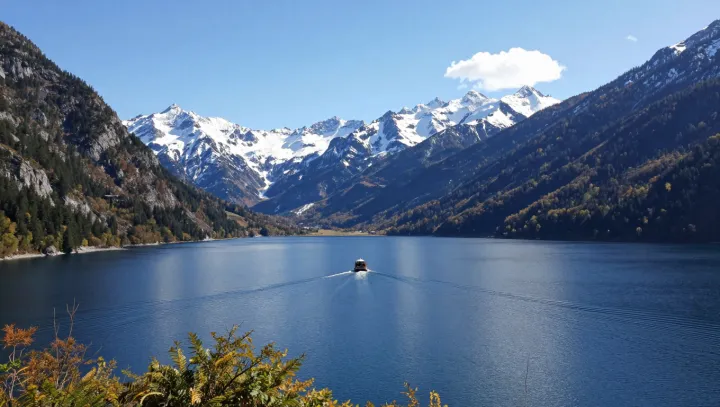
Tianchi keeps its color by refusing the usual mountain-lake destiny. Many iconic high basins slide toward pea-green as nutrients creep in and algae seize the opportunity, but this crater pool in the Tianshan range holds a different set of cards in its physics and chemistry.
First comes the pipeline. Snow and glacier melt reach the basin after percolating through rock and debris, which strips out much organic matter and leaves water low in nitrate and phosphate, the basic reagents for eutrophication and dense phytoplankton growth. With little nutrient input from sparse soils and limited human disturbance on steep slopes, the lake dodges the biological engine that normally clouds similar sites.
Counterintuitively, the so-called glacial flour helps the blue, rather than killing it. Microscopic mineral particles scatter shorter wavelengths of light through Rayleigh-like processes, reinforcing the blue signal while still allowing long optical path lengths before photons are absorbed. In many other lakes, comparable sediment loads are mixed with higher dissolved organic carbon, which turns the water tea-colored and shortens the depth at which light can travel.
Water motion then locks in the effect. Strong vertical mixing and low surface temperatures limit thermal stratification, keeping oxygen levels high throughout the column and slowing the build-up of reduced compounds that can tint water or feed further blooms. With a deep basin, modest inflow, and a relatively long residence time, fine particles either settle or remain in a stable, dilute suspension, so the surface looks clear rather than milky.
So Tianchi’s clarity is less a miracle than a tight natural protocol: oligotrophic chemistry, glacially filtered inflow, controlled mineral scatter, and active mixing combine to hold the usual greening process at bay while similar “heavenly” lakes elsewhere surrender to algae and mud.