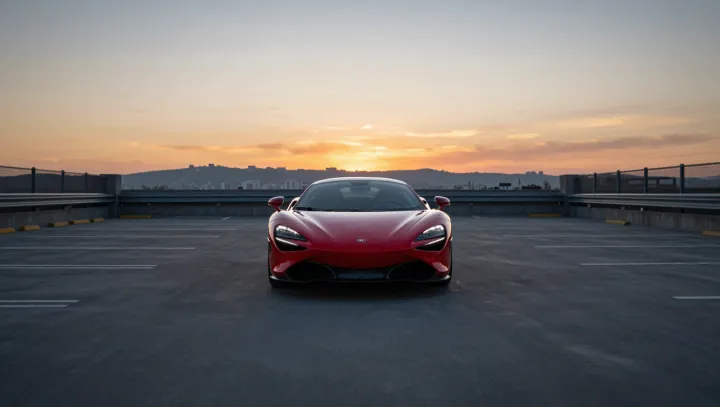
Engine noise, not horsepower, defines Ferrari’s real obsession. The brand quietly treats absolute mechanical perfection as a problem, not a prize, because a vibration-free V8 or V12 would feel sterile to the driver.
Ferrari’s position is blunt: a clinically smooth powertrain kills drama. Inside its development cells, engineers use noise, vibration and harshness (NVH) analysis and harmonic tuning to shape combustion pulses, then stop short of erasing every quiver. They let a narrow band of torsional vibration travel through the crankshaft, and they accept a trace of throttle lag in transient response, because those tiny irregularities give the driver something physical to read through the steering wheel and seat.
Purity, for Ferrari, is not silence but character. Intake resonance is tuned to produce a rising wail under load, with pressure waves deliberately allowed to overlap rather than align into a smooth, flat tone. Exhaust backpressure is managed so that gear changes carry a slight flare and crack, instead of a muted, uniform whoosh. The engine control unit could smooth these artifacts with software, yet calibration teams leave selected deviations intact, arguing that a perfectly linear torque curve and perfectly filtered cabin would make the car feel fast yet oddly anonymous.