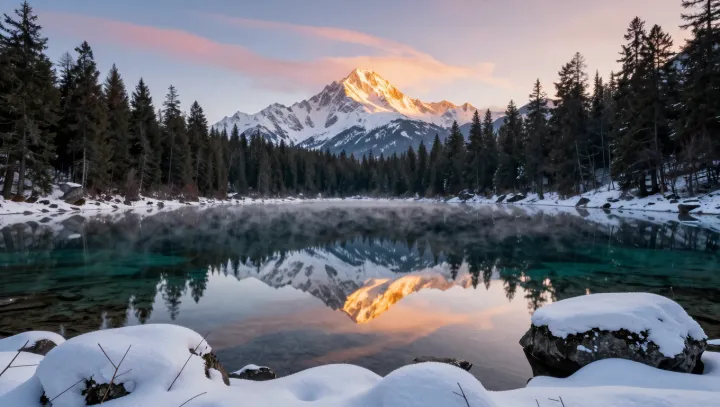
A frozen lake should kill the mirror. Yet under the right light it sharpens it. At low sun angles, smooth ice and the air just above it behave together like a single optical interface, sending most incoming rays back instead of scattering them into chaos.
The key is not cold, but order. When wind drops, the air boundary layer over the lake turns laminar, so light meets a stable refractive index gradient rather than turbulent eddies that would shear and blur the image. On the surface itself, freeze–thaw cycles often polish the ice and lay down a hair‑thin meltwater film. That nearly flat film acts like a glass sheet with a controlled Fresnel reflection, boosting specular return while suppressing random diffusion from tiny surface defects.
Even the snow line helps. Where snow is absent, bare black ice absorbs stray photons, increasing contrast between the reflected ridge and the dark foreground. Low solar elevation stretches the path of light through the clear atmosphere, favoring longer wavelengths and producing that saturated alpenglow the mirror faithfully copies. So the lake is not a passive plate of frozen water at all, but a tuned optical system in which surface roughness, boundary‑layer physics and geometric optics quietly cooperate to hang the mountains upside down beneath the sky.