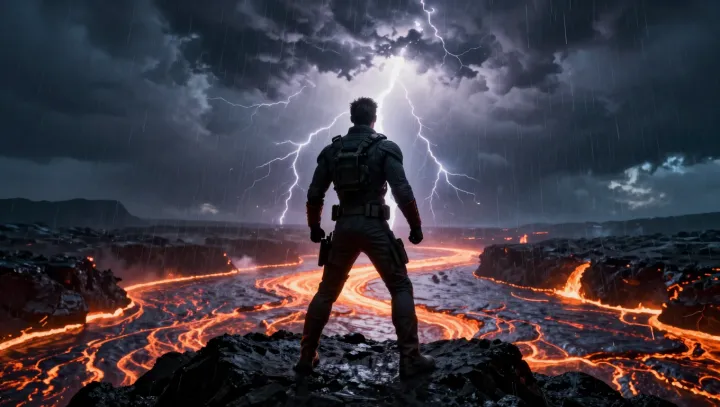
Molten rock does not negotiate. At about one meter from a typical lava flow near one thousand two hundred degrees Celsius, radiant heat flux can exceed fifty kilowatts per square meter, enough to cause third degree burns in seconds and rapid heat stroke as core temperature climbs past forty two degrees.
The harsher truth is that air, not rock, finishes the job. Superheated air above one hundred degrees can burn unprotected lungs with a single inhalation, while volcanic gases like sulfur dioxide and hydrogen fluoride corrode airway tissue and disrupt calcium balance; at high concentration, a few breaths can trigger laryngospasm, pulmonary edema, and fatal arrhythmia before the skin even blisters.
Lightning is less forgiving still. A typical cloud to ground discharge delivers tens of kiloamperes with a potential difference of millions of volts, but the lethal element is current density through the chest; as little as fifty to one hundred milliamperes across the myocardium for fractions of a second can induce ventricular fibrillation that stops effective circulation almost immediately.
Survival close to either hazard demands distance and barriers, not toughness. Fire proximity suits with aluminized outer layers can briefly reflect intense radiant heat, and Faraday cage style enclosures can route lightning current around a human body, yet bare skin in open air, within a few meters of lava or on open ground under a strike, meets thresholds that modern burn and cardiology data treat as unsurvivable.