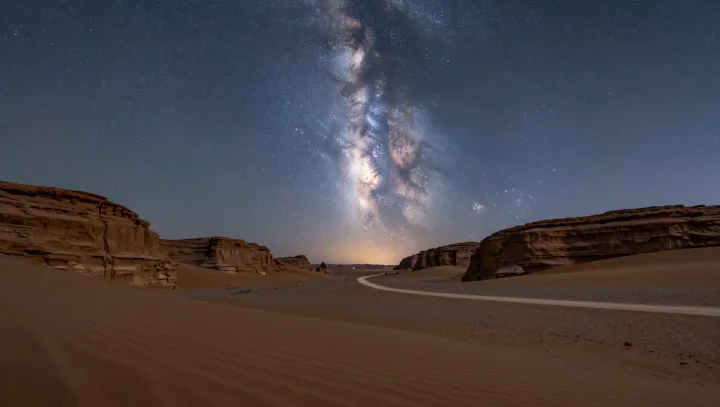
Darkness does not hide the galaxy; city light does. Over an empty desert, the Milky Way cuts across the sky as a dense, mottled band because almost every photon reaching the eye started in interstellar space, not in a streetlamp or billboard. In a city, artificial lighting adds vast photon noise, raising the sky’s luminance so high that faint structures drown below the threshold of human contrast sensitivity.
More honest, then, is the desert sky. With negligible skyglow, Rayleigh scattering and aerosol backscatter act only on natural sources, so the brightness gradient between the galactic bulge and the dark interstellar dust lanes stays intact. Urban air, saturated with upward light and particulate matter, scrambles that gradient into a uniform gray dome, erasing the fine angular structure astronomers call low-surface-brightness detail.
Counterintuitive as it sounds, the human eye becomes more capable as the scene gets darker, up to a point. In a true dark-sky site, rods dominate scotopic vision and maximize sensitivity to diffuse features, while photopic vision in cities stays locked on glaring signage and windows. Photons that could have traced spiral arms, star-forming regions and dust clouds are simply never seen, buried under the artificial luminance floor that cities treat as normal night.