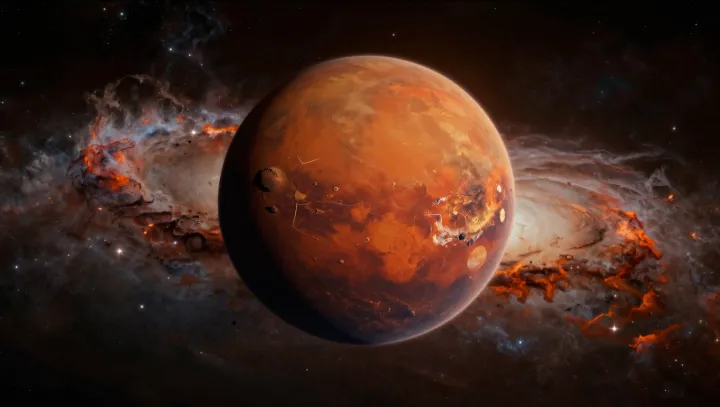
Bright ice at the Martian poles is the planet’s one act of honesty. From orbit, a dust-choked sphere pretends to be dry, yet the caps glare back as solid evidence of stored water and carbon dioxide locked in place.
Those caps endure because physics, not nostalgia, protects them. At high latitude, sunlight arrives at a shallow angle, so surface energy input stays low and sublimation slows to a crawl, while thin air and low atmospheric pressure favor direct solid-to-gas loss instead of melting. Over long cycles in axial tilt, that same geometry shifts, and polar temperatures and insolation patterns change just enough to move frost, snow, and gas between poles and mid‑latitudes, building up alternating layers of water ice and carbon dioxide ice like pages in a stratigraphic log.
The real surprise is that these frozen stacks quietly audit a wetter past. Radar sounding has mapped ice thickness on the scale of kilometers, indicating a reservoir far beyond the trace humidity of the present atmosphere, and crater counts on buried terrains show that some layers formed when atmospheric pressure was higher and liquid water could persist on the surface. In the fine structure of the polar layered deposits, climate forcing by orbital dynamics is written next to long episodes of loss, so that the same caps that now outshine a dusty red desert also preserve the memory of when that desert hosted running water.