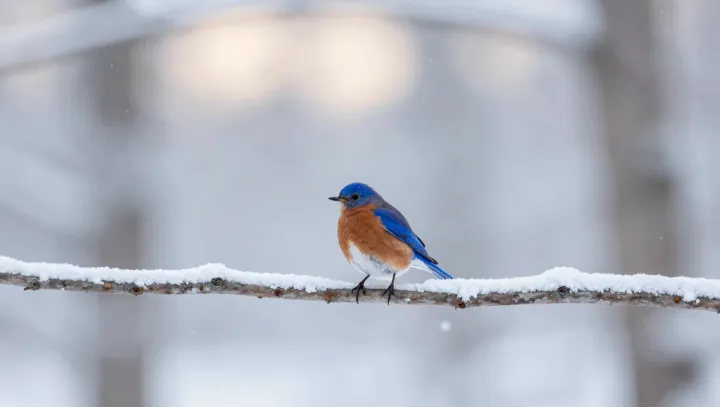
Snow does not defeat the bird; it exposes the engineering. A bird weighing less than a smartphone turns its body into an insulation device, relying on feather microstructure and metabolic heat rather than mass. Each contour feather has a central shaft and branching barbs that interlock, creating a layer of still air. That trapped air, not the feather itself, acts as the primary thermal barrier, pushing effective insulation to levels comparable to high‑end synthetic jackets.
Heat, not cold, is the real threat, because losing it too fast means metabolic collapse. By fluffing, the bird increases feather depth and air volume, slashing conductive and convective loss described by basic heat‑transfer equations. Feet are liabilities, so they vanish: tendons pull them into belly feathers, while countercurrent heat exchange in the legs recycles warmth from arterial blood into returning venous blood before it can be dumped into the snow.
Posture finishes the job. A slight hunch, a rotated shoulder, a shifted tail change the bird’s surface area, boundary layer thickness, and exposure to wind, all under tight control from thermoregulatory centers in the hypothalamus. Those micro‑adjustments run like a closed‑loop feedback controller, matching shivering thermogenesis and oxygen use to the storm outside, until the blizzard ends or the fuel runs out.