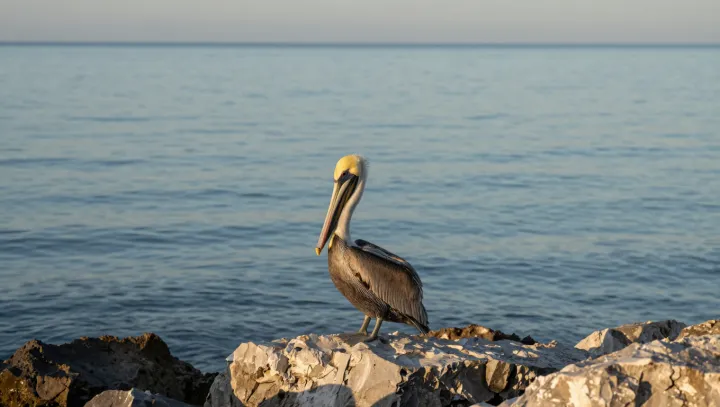
Against hard wind and blown spray, the pelican looks badly designed. That drooping pouch, that patchy, oily coat, read as clumsy excess until the bird hits the water and the system snaps into focus.
The bill is not oversized; it is calibrated fishing gear. Its lower mandible flexes like a sprung frame, turning the gular pouch into a temporary trawl net while the upper mandible works as a rigid clamp. Surface tension, refraction and impact drag would scatter prey for most birds, yet the pelican beats this with a steep plunge angle and a rapid closing action that turns kinetic energy into a controlled scoop. Muscles at the base of the bill squeeze out water while keeping slippery fish pinned, so the pouch becomes both sieve and live holding tank.
More radical still is the featherwork. Those ragged, oily plumes act as a self-healing drysuit. Each contour feather hooks into its neighbor through the barb and barbule lattice, while waxy secretions from the uropygial gland migrate along capillary channels to create a hydrophobic film. The result is a micro-layer of trapped air that boosts buoyancy and slows conductive heat loss in cold, saline water. Salt crystals and sand would wreck a smooth, cosmetic coat; a seemingly unkempt surface instead breaks up spray, sheds brine, and allows local feather replacement without compromising the whole shell.
What looks like mess is optimization. Bill and feathers, working as coupled hardware, turn a heavy-bodied bird into a precision fishing platform that can hit rough surf, shrug off salt, and lift off again on a cushion of trapped air.