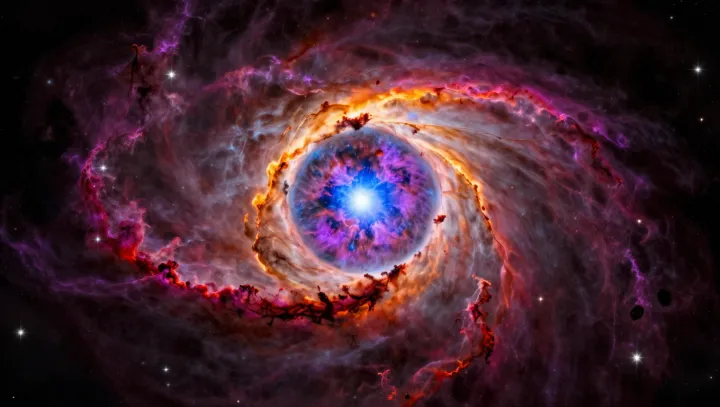
Not chaos, but choreography, hides inside that unblinking cosmic eye. A dying star, entering its planetary nebula phase, sheds its outer layers in pulses, while radiation pressure and stellar wind strip gas away at different speeds and densities. Around the remnant core, ionization fronts light up those layers unevenly, so what looks like a smooth iris is actually a stack of shells, each responding differently to ultraviolet photons.
The real sculptor, though, is geometry. Many eye-shaped nebulae almost certainly come from binary systems, where the companion star forces the outflow into a dense equatorial ring and thinner polar lobes. Once that torus forms, line-of-sight projection does the rest: viewed edge-on, the bright ring becomes an iris, the hollow interior a pupil. Add radiative transfer effects and dust scattering, and a messy three-dimensional structure collapses, optically, into a clean, circular stare.
Magnetic fields tighten the design. As the progenitor star spins down, magnetohydrodynamic forces can collimate gas into jets and filaments, carving sharp inner rims that read as eyelids. Small asymmetries in density get erased by photoevaporation, while stable configurations of plasma and field lines persist. Out of a short, violent death, the physics of symmetry selection leaves behind something that looks almost intentional: a single, watchful eye in vacuum.