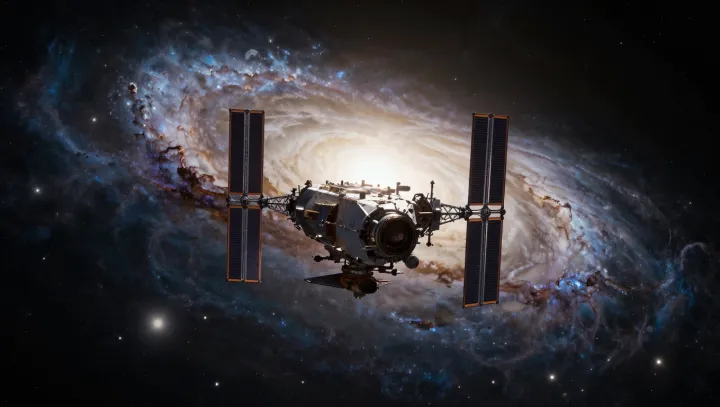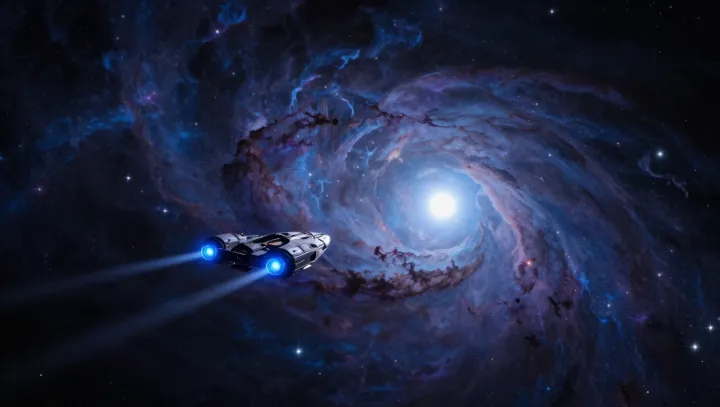
That glowing exhaust is not reacting with space at all; the fire is self‑contained. A rocket carries oxidizer, mixes it with fuel in a combustion chamber, then drives the hot products through a nozzle where pressure and temperature spike to extreme levels.
The tight, spear‑like look is mostly an illusion, and that is the interesting part. In the near‑vacuum, gas leaving the nozzle expands freely, but it begins as a highly directed supersonic jet, shaped by nozzle geometry and by conservation of momentum, so the core flow stays relatively focused over long distances before thinning into almost invisible gas.
The glow itself is a matter of atomic bookkeeping, not contact with air. Inside the exhaust, molecules are ripped apart and ionized into a partially ionized gas, or plasma; as electrons drop back to lower energy states, they emit photons at specific wavelengths, giving each propellant mix its characteristic color even when no atmosphere is present.
What misleads many viewers is experience with campfires and car engines, which absolutely do rely on surrounding air. Chemical rockets are different machines: closed systems that bring both halves of the reaction, fuel and oxidizer, so the flame can persist, shine, and stay seemingly sharp in a region that is otherwise almost perfectly empty.