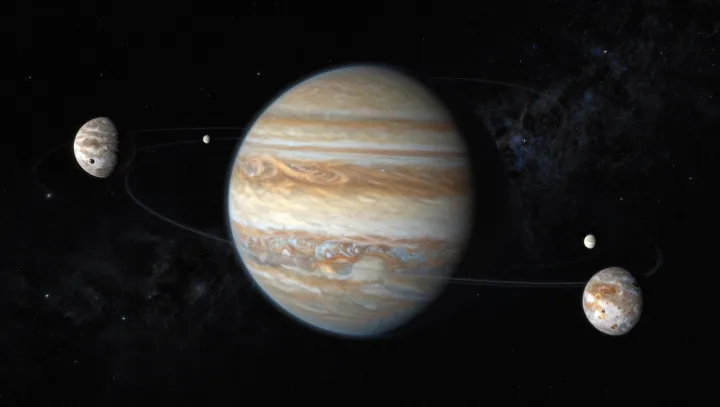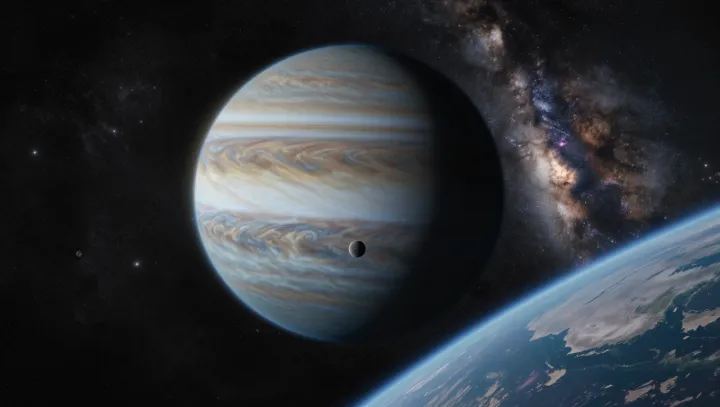
A gas giant is not a plush sphere but a thin trick played by matter and gravity. Its bulk comes from hydrogen and helium, elements whose atoms are mostly vacuum, with a tiny nucleus and distant electron shell defining the structure. Pack hundreds of Earths into that envelope and the actual nuclear material would still occupy a fraction of the volume, yet the planet’s mass is enough to bend space and dictate motion nearby.
This mismatch between atomic emptiness and planetary authority is the point. Under immense self‑gravity, the gas compresses into layers, from cold upper clouds down to hot, dense regions where hydrogen shifts toward metallic hydrogen, a phase that conducts electricity and helps power a global magnetosphere. Zonal jets carve the familiar bands as rotation and the Coriolis force shear the atmosphere into high‑speed streams, while convection cells drag heat outward in towering storms that can swallow worlds.
Even the moons and rings owe their order to this invisible grip. Within the Hill sphere, the planet’s gravity dominates over the star’s, corralling ice and rock into regular orbits and sculpting gaps where resonances clear debris. The gas may be thin and its atoms mostly space, but the total mass, folded by gravity into a deep potential well, writes the rules for everything that moves nearby.