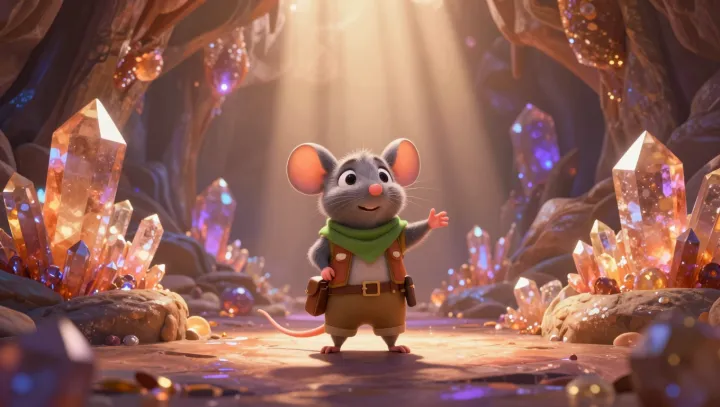
Darkness is not a disadvantage here; it is an equalizer that cuts human tools down to a mouse’s scale. In tight crystal tunnels, laser rangefinders scatter, radio links attenuate, and inertial units drift as vibrations and mineral facets throw noise into every reading while the rock itself blocks most signals outright.
The real edge belongs to contact. A mouse’s whiskers act as a live array of mechanoreceptors, sweeping walls in rapid arcs that encode distance, curvature, and surface discontinuities with millisecond precision, so each squeeze through a fissure writes fresh data into its hippocampal spatial map instead of filling a hard drive with errors from occluded optics.
Smell makes the case stronger. Human crews lose orientation when corridors repeat; a mouse layers olfactory gradients and pheromone traces over geometry, turning every junction into a chemically labeled node that resists interference in ways no LiDAR point cloud or magnetic compass can match in a maze of iron rich, signal twisting stone.
Memory finishes the argument. Once a mouse has run a branching network a few times, place cells and grid cells in its medial temporal lobe stabilize a cognitive map that survives dust, crystal glare, and equipment failure, letting the animal retrace, shortcut, and re route through the cavern with a reliability that makes it a low tech but superior envoy.