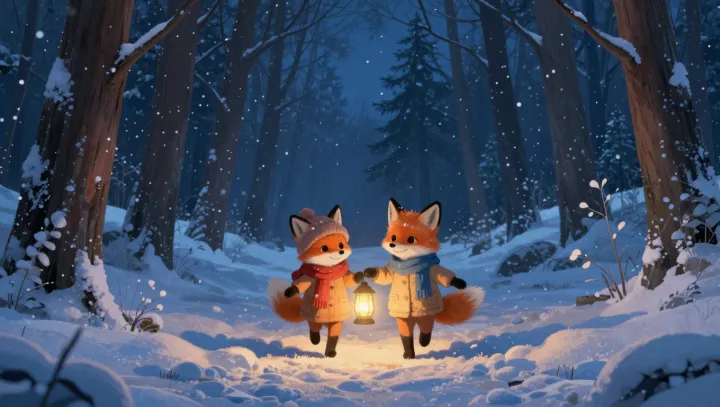
Snow does something subversive to the night. Under a white canopy, darkness stops feeling like a predator and starts behaving like a dimly lit room, because snowpack massively boosts albedo and scatters even weak moonlight into usable luminance. The visual cortex receives cleaner edges, higher contrast, fewer blind corners; the amygdala, tuned to ambiguity and sudden motion, gets less noisy input to flag as threat, so ancient fear circuits idle instead of firing.
Equally deceptive is the sound. A snowy forest feels hushed, yet that quiet is not absence but filtration, as porous snow crystals absorb high-frequency noise and flatten echoes in a kind of natural acoustic low-pass filter. Fewer sharp sounds mean fewer startle reflexes, less sympathetic arousal, lower cortisol. Prey animals move more slowly in deep snow, predators waste energy breaking trail, and the statistical base rate of surprise encounters drops, teaching the brain across generations that this specific darkness is statistically kinder than the rest.
Most seductive, though, is the narrative we project. Human memory has stored winter woods not just as hunting ground but as campsite, fire circle, shared shelter, so the hippocampus pairs that eerie blue glow with social safety cues rather than pure hazard. The forest has not changed its capacity for danger; snow has simply hacked the interface through optics, acoustics, and memory, until the night feels like it is on our side.