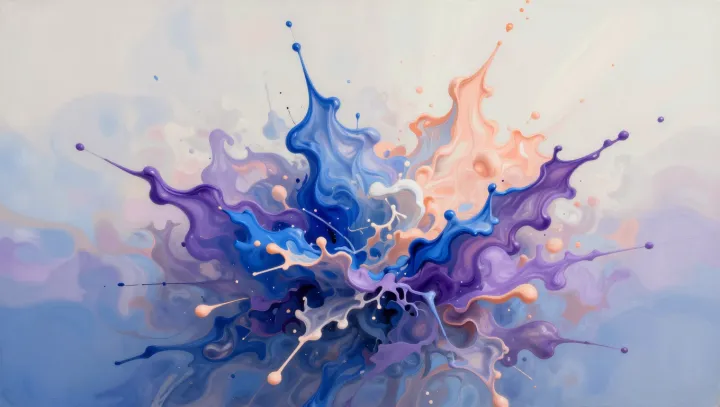
That blue‑violet burst is not an accent; it is the opening shot. Before any object takes shape, the visual system snaps to raw contrast and sudden chromatic edges, treating them as high‑priority alerts in a field of quieter gradients and soft transitions.
What feels like “seeing a thing” is, in practice, a latecomer. First, photoreceptors and retinal ganglion cells run edge detection as if they were a biological version of a high‑pass filter, tuned to light‑dark discontinuities and color boundaries rather than to chairs, faces, or trees. Short, sharp spikes in luminance or hue drive these cells to fire, while steady surfaces are largely discounted as background noise by lateral inhibition and center‑surround organization.
Only after this coarse, contrast‑coded sketch reaches the primary visual cortex does object recognition even get a vote, with feature maps and receptive fields trying to assemble contours into something nameable. A violent blue‑violet edge hacks that queue, because S‑cone pathways and opponent‑process circuits flag it as a strong anomaly against the prevailing spectrum, forcing attention toward the edge itself before the mind can promote any stable idea of what, exactly, sits there.