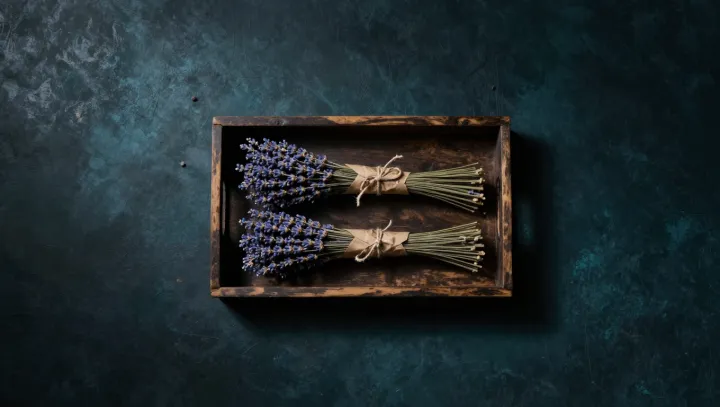
Two inert-looking lavender bundles are not inert at all. Against a bowl of fruit and a neutral wall, they operate like a slow, invisible diffuser, releasing volatile organic compounds that accumulate in the still air. Those molecules, dominated by linalool and linalyl acetate, reach measurable parts-per-billion levels, enough for gas chromatography but also enough for the far more sensitive human nose.
The stronger claim is this: the room’s story changes before the objects do. Once airborne, lavender terpenes pass across the nasal epithelium, bind to olfactory receptors, and trigger patterned firing in the olfactory bulb, which projects directly to the amygdala and hippocampus. That wiring shortcut, well described in sensory neuroscience, lets a trace of fragrance bias emotional appraisal faster than visual cortical processing can fully parse the still life’s edges and shadows.
More radical is the idea that the “simple” still life is already mixed media. Odor plumes follow fluid dynamics, curling around the dried stems and ceramic surfaces, so that the composition extends into a three-dimensional chemical field. Psychophysics studies show that lavender exposure can shift reported calmness scores while leaving the visual array untouched. The canvas, it turns out, now includes the air between viewer and object.