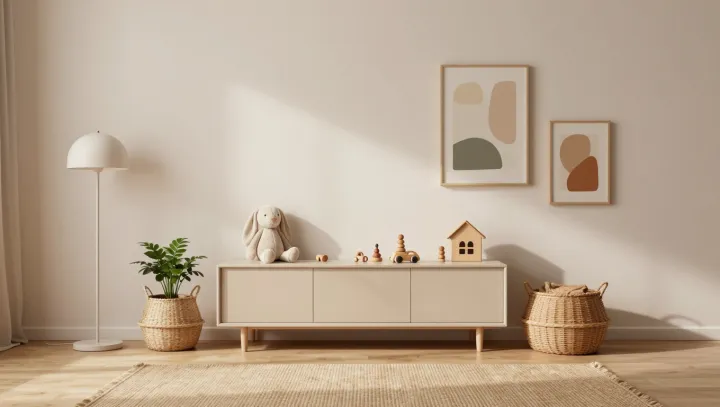
Silence has a color, and in nurseries it is beige. Against soft neutrals, a single wooden rattle suddenly matters more than a wall of plastic distractions, because an infant’s visual cortex is still wiring basic circuits for contrast, depth, and face recognition.
The blunt truth is that many nurseries are built for adults’ Instagram feeds, not for a baby’s immature sensory system. Developmental neuroscience shows that the infant brain is highly sensitive to “stimulus density”; too many saturated colors and competing shapes spike arousal in the reticular activating system and make it harder for the prefrontal cortex to begin crude attempts at regulation. Strip the room back and you lower the baseline level of cortical activation, so a baby is not constantly fighting background visual static.
Calm walls also act like acoustic panels for the eyes. With fewer objects demanding “orienting responses,” the oculomotor system spends longer on a parent’s face or a single toy, which supports sustained attention and early working memory. That simple wooden block is not quaint decor; it is a clean data point for the brain’s pattern-recognition and sensorimotor integration, without the confounding variables of blinking lights and noise.
Emotional self-soothing begins in this quieter field. When the environment is predictable and low in entropy, the infant’s autonomic nervous system drifts toward parasympathetic dominance, heart rate steadies, and the association forms: this room means safety, not surprise. Warm neutrals and a few wooden toys are less a style choice than an environmental intervention, giving a still-fragile brain fewer signals to filter and more space to rest.