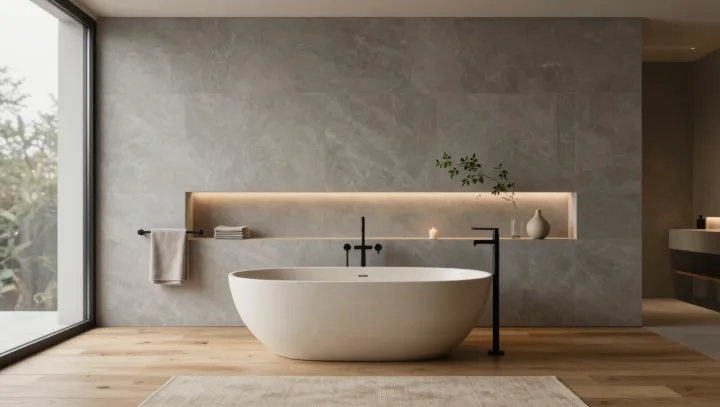
A tub pressed against stone reads less like clutter and more like architecture. That contact line fuses object and wall, creating a single visual mass rather than two competing volumes, so the eye tracks one continuous surface instead of stopping twice and shrinking the room in perception.
The real surprise is how this tight pairing edits movement. With the bath locked to the perimeter, circulation compresses to a clear corridor, which environmental psychologists link to reduced cognitive load and lower sympathetic arousal. Warm stone with a higher thermal mass keeps surrounding surfaces closer to skin temperature, cutting the cold-surface contrast that often makes compact bathrooms feel harsh and clinical.
Texture plays quiet tricks here. Honed stone breaks glare and softens specular reflection, while the curved tub front bounces diffuse light back into the room, an optical effect akin to increasing apparent luminance without adding fixtures. By eliminating a cleaning gap and visual shadow line behind the tub, the junction stays legible and calm, so the space feels edited, not empty, and the mind registers refuge rather than shortage.