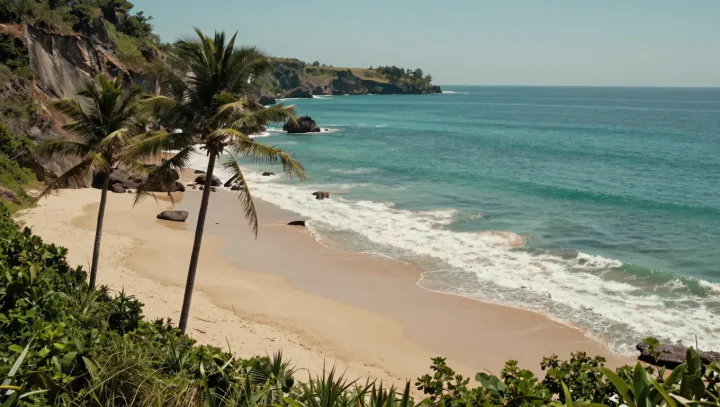
Color here lies first. Water that looks like a postcard lagoon can sit only a few degrees above freezing, because hue is ruled less by temperature than by the physics of light and whatever is floating in the upper few meters.
The key trick is scattering. Tiny particles and microscopic life in cold coastal water intercept incoming sunlight, then throw selected wavelengths back toward your eyes while letting others sink into depth. Glacial flour, the rock powder ground by ice, is especially ruthless: its fine grains boost Mie scattering, bouncing blue and green photons while muting reds. Add phytoplankton with chlorophyll absorption, and the spectrum is carved again, so the surface flashes tropical turquoise even as heat content stays low, locked by upwelling and polar currents.
Human vision finishes the deception. Our color perception, tuned by trichromatic cones and opponent processing, treats that saturated blue green as a proxy for warmth and leisure, because past experience has wired beaches and resorts to that palette. The brain does not sample thermal energy; it samples contrast and context. Along cold coasts, that shortcut fails, and the same optical rules that paint a glacier lake like the Caribbean quietly remind us how easily a change in particle size and light angle can overwrite common sense.