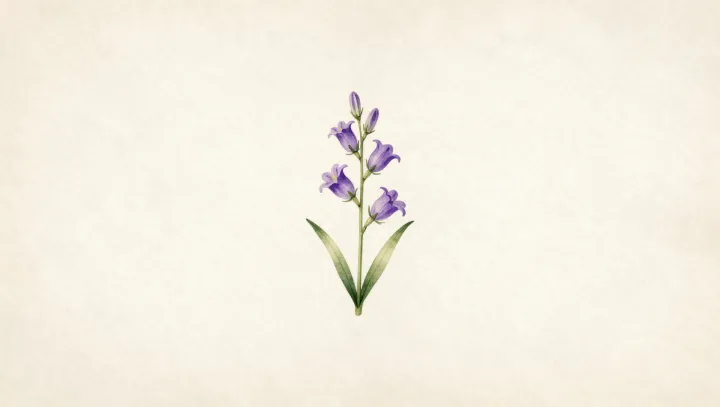
Bellflower stability is less a miracle than a pressure hack. Each bloom rides on a stem that behaves like a water-filled column, its firmness set not by solid support but by internal hydrostatic pressure that engineers would recognize as turgor pressure.
The key claim is blunt: the plant stays upright only as long as its cells stay inflated. Inside the stem, water drawn through xylem conduits floods into parenchyma cells, whose semi-rigid cellulose walls resist stretching, so rising osmotic potential turns every cell into a tiny pressurized chamber that collectively stiffens the stem like a bundle of microscopic air tanks.
Wind, not gravity, is the real design test. As gusts bend the stem, those pressurized cells deform slightly and then rebound, allowing elastic strain without permanent buckling, while the narrow, tapering geometry of the stem shifts mass close to the central axis, cutting bending moments from the top-heavy corolla and distributing mechanical stress along the vascular cylinder.
The bold part of this strategy is its reversibility. Lose water and the stem slumps as turgor falls; regain it and the plant re-erects the bloom without laying down a gram of new lignified tissue, running on a dynamic hydraulic architecture that trades rigid armor for adjustable, low-cost stiffness.