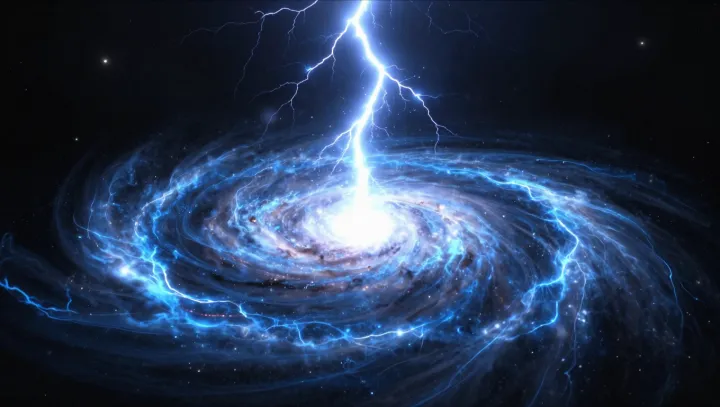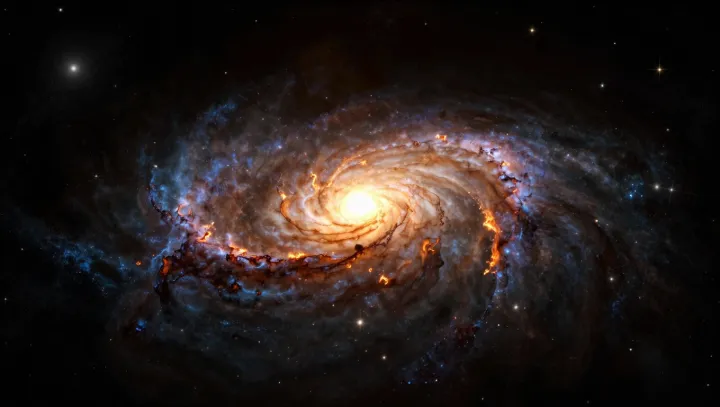
A galaxy looks fragile when its stars stream out in tidal tails, yet the system is anything but. Those hundred‑thousand‑light‑year arcs are the signature of tidal forces, not a sign that gravity has lost control of the main body.
The key fact is simple. Tails come from the outskirts. The inner disk and bulge sit deep inside the galaxy’s gravitational potential well, shaped by a massive dark matter halo and dense stellar core, so their self‑gravity easily outguns the stretching force from a passing companion. Only stars and gas near the edge, where orbital speeds and binding energy are lower, feel a strong enough tidal differential across their orbits to be flung out along elongated paths.
The more counterintuitive point is that this stretching is highly selective. During a close encounter or merger, the changing gravitational field applies a tidal torque that redistributes angular momentum rather than shredding everything at once. Gas clouds in the outer disk are pulled into long, curved streams, while the inner regions respond mostly by re‑shaping or thickening the disk through dynamical heating and violent relaxation. That is why spectacular tails can coexist with a recognizable central galaxy, still bound, still rotating, framed by debris it has thrown into intergalactic space.