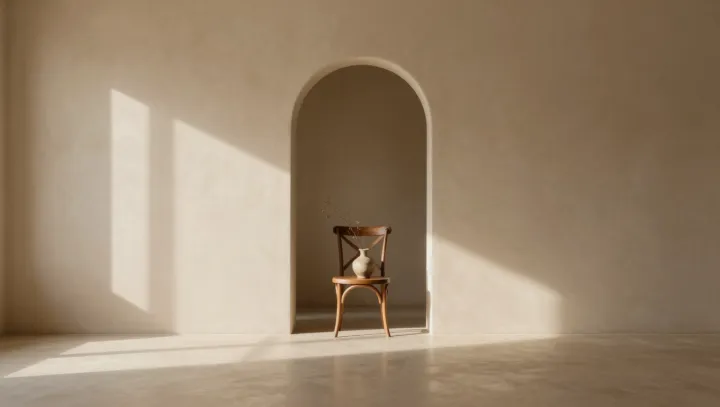
A beige corner does more work than any blue‑light filter when its harsh ceiling glare is replaced by a soft, warm pendant. Light shifts. Shadows relax. Screens stop screaming. That small change, lighting researchers say, alters the entire visual task your eyes are forced to perform each evening.
The blunt truth is that most overhead fixtures push a high luminance point straight into the fovea, forcing constant pupil micro‑adjustments and raising retinal contrast against a dimmer room. By lowering luminance and bouncing warm light off beige walls, a pendant cuts that contrast ratio and stabilizes accommodation, so ciliary muscles fire less and the trigeminal system gets fewer “strain” signals.
The bigger win hides in biology. Cooler overhead light dumps excess melanopic lux into the eye, suppressing melatonin and keeping the suprachiasmatic nucleus wired for daytime. Warm, lower‑intensity pendant light drops that stimulus, easing circadian arousal while still giving enough horizontal illuminance for text clarity. Beige surfaces act as a broad diffuser, smoothing luminance gradients so the visual cortex processes cleaner, less noisy edges. Screen time stays identical; the metabolic cost of seeing quietly falls.
So the beige corner, once flattened by glare, becomes a low‑contrast envelope around a single glowing circle, and the body reads it not as a workstation under attack but as a space where the day is finally dimming.