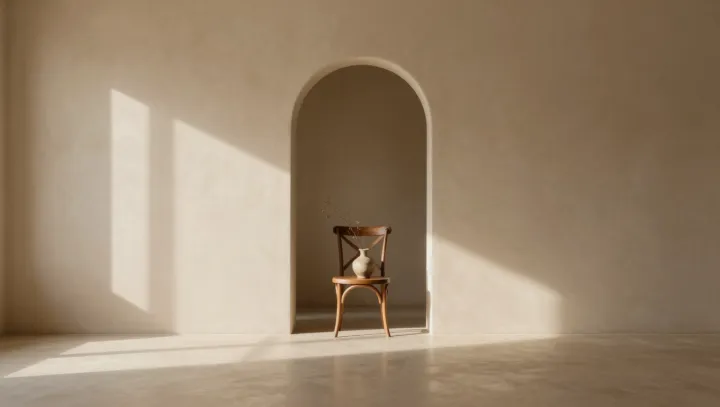
An empty arch can stretch a room more than any built-in cabinetry. Light slips through, shadow pools at the curve, and the opening reads as pure width on the retina, not as an object with edges and handles and seams that must each be counted by the eye.
The real trick is cognitive load, not square footage. When a wall of smart storage fills a view, the visual cortex and working memory must parse every door line, shelf break, and color shift; psychophysics studies using eye-tracking and saccadic latency show that each extra contour is more “data” for the brain to resolve before it can form a stable map of the room.
By contrast, a lone wooden chair and one vase with branches act almost like calibration points. They give scale, they anchor proportion, yet they barely increase what psychologists call stimulus density, so the brain completes the rest of the envelope as uninterrupted volume, widening it through perceptual completion and reducing sympathetic arousal in the process.
Storage-heavy walls often shrink space twice, first by stealing literal depth, then by raising what environmental psychologists label information rate, which tightens posture and compresses how far the room feels walkable; the sparse trio flips that ratio, offering enough function and narrative for living, but not enough noise to crowd the mind.