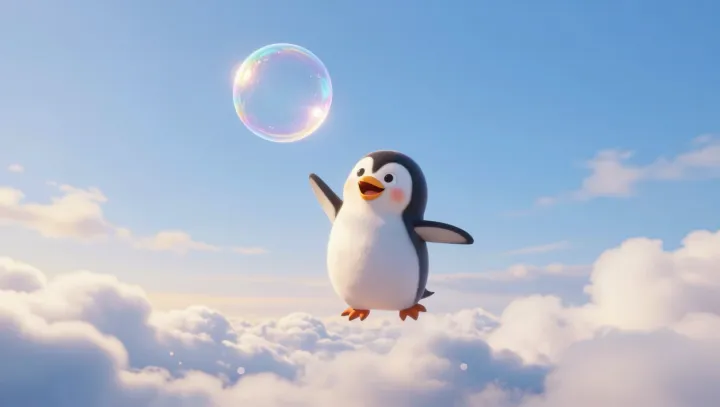
A soap bubble is a better color showman than a penguin. That sounds backwards, since the bird carries a full body of engineered microstructure, while the bubble is almost nothing: a nanometer-scale sandwich of water between two layers of surfactant. Yet that near-uniform thickness turns the bubble into a textbook thin film interference device, tuning reflected wavelengths with small shifts in film height.
Penguin plumage, by contrast, plays defense first and optics second. Feathers must trap air, manage heat, survive ice, and only then cheat light using structural color built from keratin matrices and melanosomes. Those internal photonic structures scatter and interfere with light, but they do so across many length scales and orientations, which broadens and damps the spectral purity that a smooth, continuous film can reach.
The bubble wins on one simple edge: coherence. Over each glossy patch, its surface behaves like a continuous optical cavity, so phase differences between reflections at the air–film and film–air boundaries are tightly linked to thickness and refractive index. That sharp control yields vivid, angle-sensitive bands. Feather arrays, broken into barbs and barbules with rough contours and varied spacing, fragment that phase relationship, mixing wavelengths and muting the palette across the animal’s body.