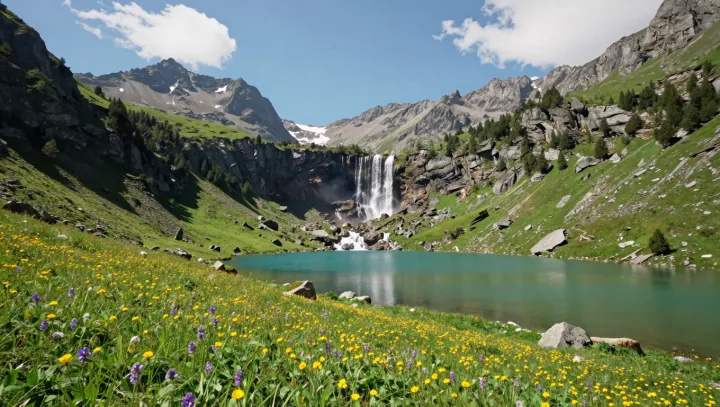
That unnervingly bright turquoise is not a filter; it is physics suspended in water. An alpine lake fed by glaciers becomes a liquid prism because it is loaded with rock dust, not algae or dye.
The key agent is glacial flour, a fine sediment ground by ice against bedrock in a process known as abrasion. Each particle is tiny, often in the micrometer range, so it does not settle fast. Instead it hangs in the water column, forming a stable suspension. Those mineral grains scatter incoming solar radiation through Mie scattering, bouncing shorter blue and green wavelengths toward your eyes while letting more red light sink or pass through.
Cold water is the quiet enforcer here. It slows sediment settling, limits biological growth, and keeps the optical signal clean. With low nutrient input, there is little chlorophyll to muddy the spectrum or tilt the hue toward green-brown tones. The result is a narrow, intense color band, sharpened whenever direct sunlight strikes the surface at a low angle and penetrates the upper meters.
So the lake looks fake precisely because it is so simple. Rock flour stays afloat, sunlight hits, selective scattering does the rest. No pigments, no chemical dyes, just geology, optics, and cold working in ruthless alignment.