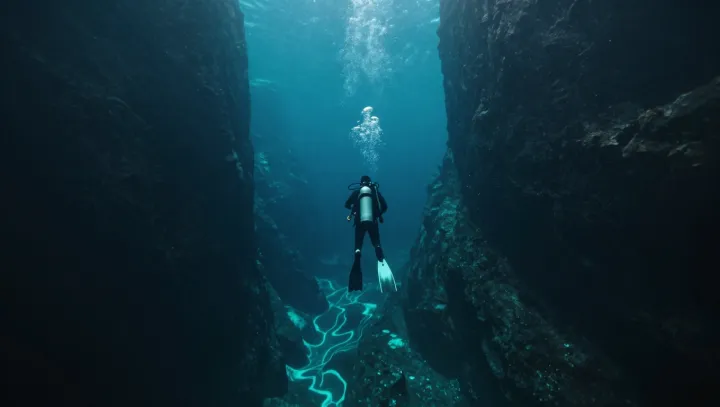
Silence now lies. Your mask is busy. Inside the tempered glass frame, pressure sensors, inertial units and optical displays fold scuba’s old guesswork into a live dashboard that stares back at you with every inhale.
This sport is becoming less about instinct and more about telemetry. Air time is no longer a mental estimate; microelectromechanical pressure transducers read cylinder pressure, compute remaining gas and project a countdown on a head up display, while depth and ascent rate are derived from hydrostatic pressure curves and accelerometer data to guard against decompression sickness. Where a slate once carried crude tables, firmware now runs Bühlmann algorithms and tissue compartment models, revising no decompression limits on each breath.
Safety, not spectacle, is the real disruptor. Masks and wrist units form low power acoustic meshes, pinging through water so that a buddy’s position, depth and air reserve appear as icons, a kind of underwater ADS B built on ultrasonic ranging and signal time of flight. Heart rate and skin temperature from photoplethysmography and thermistors feed into load estimates, flagging overexertion before panic or nitrogen narcosis spiral. Logged afterward, the same packets become performance analytics for coaches, who now compare buoyancy control traces and SAC rates the way cyclists scrutinize power curves.