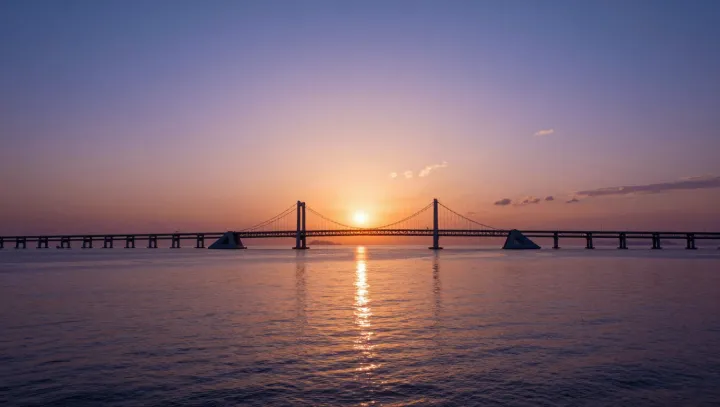
That blazing sky behind the bridge is a sign of loss, not excess. Light from the Sun starts out broad, a full spectrum of wavelengths, yet the trip through the thick, low-angle atmosphere becomes a brutal selection process governed by Rayleigh scattering and optical depth.
Harsh is the filter. Shorter wavelengths, especially blue and violet, interact far more strongly with tiny gas molecules because Rayleigh scattering scales as the inverse fourth power of wavelength, so as the path length grows near the horizon, those colors are preferentially scattered out of the direct beam and dumped sideways across the sky as diffuse glow.
What survives is the long game. Red and deep orange photons, with their larger wavelengths and reduced scattering cross section, slip through this extended column of air with far fewer collisions, so by the time the Sun drops behind the bridge, the direct solar disk and its halo are spectrally stripped, their irradiance in shorter bands depleted while the long end dominates the signal reaching your retina.
Misleading is the drama. The fiery look suggests extra energy, yet radiative transfer here is about subtraction, about the atmosphere acting like a biased spectrometer that edits out blues and greens, leaving a red-weighted remnant that turns steel trusses into silhouettes and makes a routine sunset feel like a furnace door.