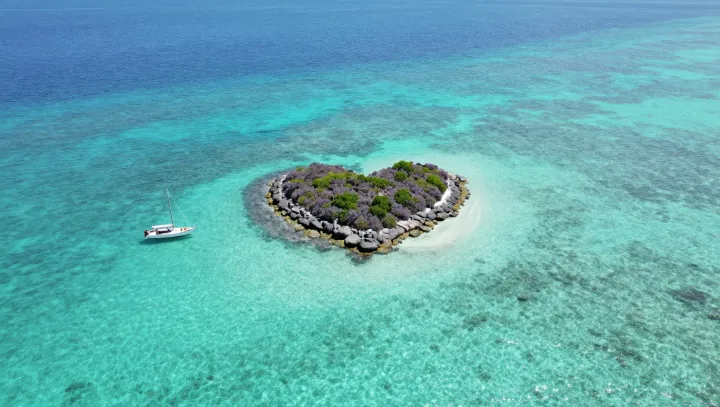
That postcard-blue ocean shot is lying to your brain. The water may be real, yet without a boat, buoy or rock, your visual system quietly flags the scene as suspiciously flat. Empty expanses strip away the anchors that depth perception depends on, so the image collapses into a glossy sheet of color.
The odd part is simple. Your brain expects scale. In normal viewing, size constancy and linear perspective work together with binocular disparity to estimate distance. When the frame holds only uniform water and sky, those algorithms starve. The horizon becomes just a stripe. The surface, a pattern with almost no texture gradient. Your visual cortex, especially areas tuned to stereopsis and motion parallax, has almost nothing to compute with.
A tiny boat fixes it. Instantly. That speck gives relative size, occlusion, and implied motion, which restore geometric context across the whole frame. Now the horizon is far, not just high. Now the waves are big, not just blotchy. Photographers know this intuitively: drop a minuscule subject into the void and the ocean stops being wallpaper and snaps back into three dimensions.