Spring light on a young woman’s face often feels more honest than any studio portrait. Not because of optics. Because her body has not yet been fully colonized by self-surveillance, that slow behavioral editing which psychology calls self-monitoring and impression management.
The claim sounds harsh. Adult portraits lie before a word is spoken, as years of reputational calculus recruit motor cortex and autonomic nervous system into a kind of permanent media training. Shoulders tighten by habit. Neck angles shift toward the most shareable profile. Extraocular muscles steer the eyes to lens and screen rather than to petals, people, or sky, following an internal script about how a photographed person ought to look.
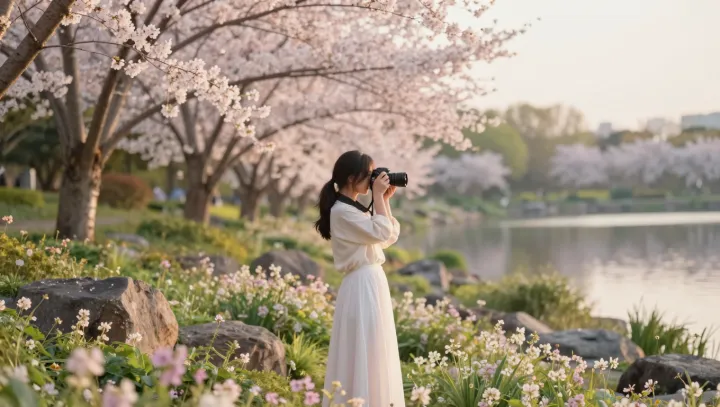
By contrast, the girl lost in photographing blossoms has not yet outsourced every gesture to that script. Her posture still tracks proprioception and curiosity more than imagined feedback loops. Social psychologists studying self-presentation describe this as lower chronic self-monitoring: less continuous scanning of how behavior will read to an invisible audience, fewer micro-corrections in facial musculature and gaze. The camera, arriving almost as an afterthought, records movement organized around the world, not around the watching eye.
So the candid frame feels true. Not because the lens is neutral, but because the subject’s nervous system has not fully reconfigured itself into a branded surface, ready for comment sections long before the shutter closes.