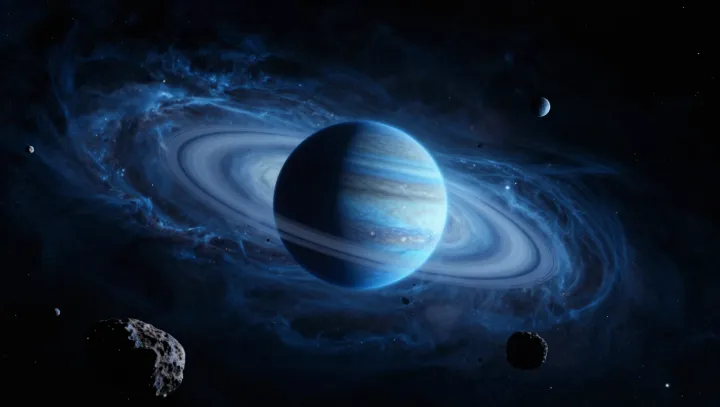
Twilight would stop being romantic and start being architecture if a ringed blue gas giant hung overhead. A planet wide and bright enough to outshine the full Moon by thousands of times would not flirt with darkness; it would erase it, yet still obey both orbital mechanics and biology.
The physics points to something surprisingly modest in size. Think a Neptune‑class body, about four times Earth’s radius, wrapped in a Saturn‑like ring system that doubles its effective emitting area. Put that world roughly five to ten Earth radii above the surface, in a tight but Hill‑stable orbit just outside the Roche limit, and its illuminated disk plus rings can reach surface illuminance well above ten thousand lux, far more than solar noon on Earth, once reflected stellar flux and albedo are folded into the radiative transfer math.
Human eyes, paradoxically, set a softer ceiling than gravity. Retinal photoreceptors saturate long before thermal injury, and the photochemical safety margins used in ophthalmology show that continuous exposure near bright overcast daylight is tolerable, though it crushes circadian cues. At the calculated distance, the gas giant’s apparent diameter would span tens of degrees, its rings forming a luminous band that never sets, delivering luminance in the high candela‑per‑square‑meter range yet still below thresholds associated with acute photic damage, turning the idea of night into a biological technicality rather than a visual reality.