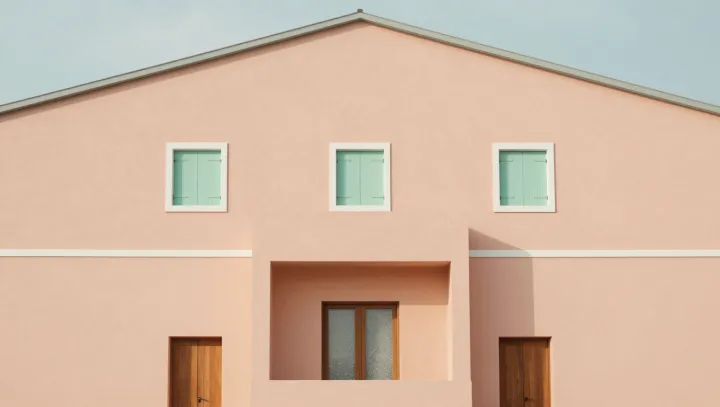
A flat pastel facade should feel mute, yet it behaves like a strict visual script. Soft color, repeated windows, and a single recessed panel appear minimal, but together they trigger the same compositional instincts that guide viewers through a Renaissance altar piece with surgical precision.
The bold claim is this: repetition is doing the narrative work that figures once did. Identical window bays set up rhythm; perception studies call it Gestalt grouping and spatial frequency, the brain locking similar elements into one beat. Against that grid, a recessed center panel breaks the pattern, exploiting figure–ground segregation so the eye snaps to the interruption as if it were a saint framed in gold.
Even bolder is the idea that geometry quietly replaces story. The facade often follows simple proportion rules, from axis symmetry to ratios close to the golden section, which psychophysics links to efficient visual processing. The pastel plane acts as low visual noise, reducing luminance contrast so edges of the windows and the shadowed recess carry almost all the information, mimicking chiaroscuro without any painted flesh.
What feels like dead flatness is actually tight hierarchy. Baseline alignment of sills and lintels creates an invisible horizon, the recessed bay thickens that central axis, and your gaze marches up and down like a trained soldier. Where Renaissance painters used perspective projection and focal triangles, the contemporary street facade leans on depth cues and pattern disruption, proving that narrative can be stripped of characters and still hold the eye in place.