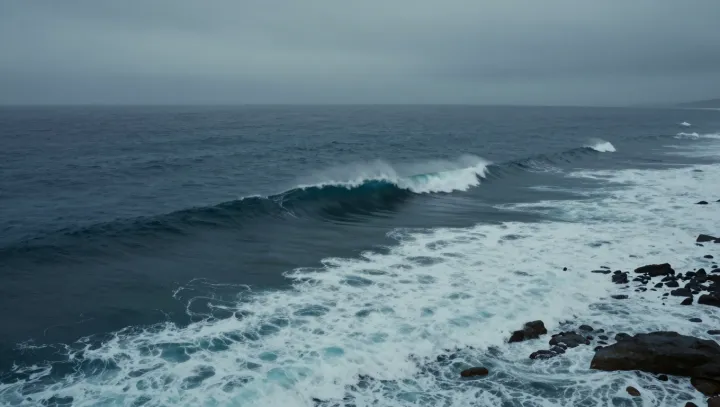
Along a frozen shore, the sharpest lines are drawn by the weakest touch. Soft, low waves do not smash the ice; they worry it. Each swell lifts and drops the ice margin, producing cyclic stress that fractures brittle plates along stress concentrators and preexisting microcracks.
This sculpting works because water refuses to stay in one state. As waves roll in, thin films of liquid seep into cracks, then refreeze when the crest passes and pressure falls, a local phase transition that locks new wedges of ice into place. Small floes grind against the fixed edge in a slow form of mechanical erosion, shaving slivers from protruding corners while the bulk sheet remains intact and buoyant over the moving sea.
Paradoxically, constant motion stabilizes the knife-edge. Repeated flexing filters out blunt, unstable shapes, leaving geometries that shed stress efficiently, much like fatigue testing in materials science. Rounded edges fracture off; only narrow, angular ridges survive the endless, low-amplitude forcing of long-period waves, which keep the ocean pulsing under a shore that looks frozen still.