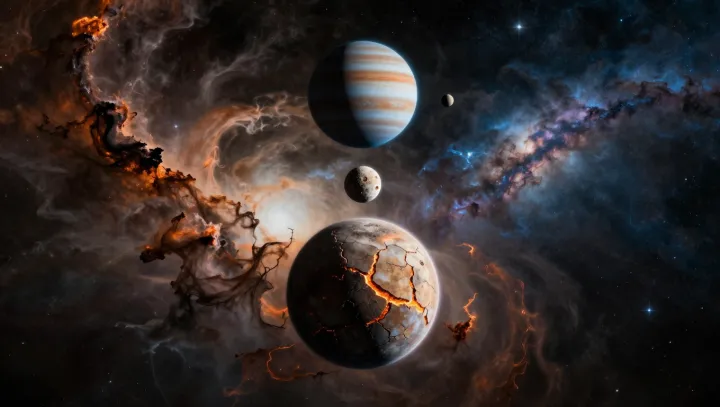
Cold is the trick. Not size, not distance. A Jupiter drifting through a glowing nebula is basically a giant power outage in space, radiating only the faint heat trapped in its own interior and whatever negligible energy it absorbs from the thin bath of starlight in the gas around it.
The counterintuitive part is simple. Bright nebulae look blazing in images, yet their gas is thin and their dust is poor at heating huge planets, so a free-floating Jupiter can sit at tens of kelvin, well below Pluto, while its thermal emission peaks in mid-infrared wavelengths that many flagship observatories only sample with limited sensitivity and small survey area.
Detection works against itself here. To see such an object you must separate a tiny, cool blackbody spectrum from a background crowded with ionized gas lines, scattered starlight and warm dust, all of which contaminate the same infrared bands your detectors use, while gravitational microlensing, the other main method, gives only brief, rare brightness spikes in background stars and almost never a repeat event.
So the universe hides them in plain sight. Giant, dark planets slip through luminous clouds, cold as deep shadow on ice, and most telescope images record only the nebula behind them, not the silent mass moving across it.