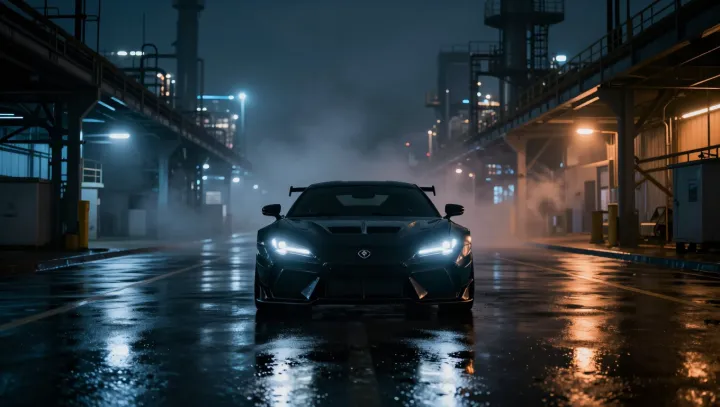
Headlight clusters now behave less like lamps and more like aerodynamic valves. Light output is only the obvious function; the hidden work happens in the air and heat they redirect around the nose of the car at speed.
Piercing rain and smoke is not magic, it is geometry and physics. Multi‑LED arrays sit behind complex projector lenses and cutoff shields that manage luminance, beam divergence and back‑scatter, pushing photons under the water droplets and particulate plumes that would bounce light back into the driver’s eyes. Short, high‑intensity segments handle near‑field spray, while a narrower, longer range segment is tuned for reduced Mie scattering in mist, assisted by adaptive control that dims regions where sensors detect dense reflection.
Airflow, though, is where the headlight housing earns its place in the wind tunnel. The outer lens is shaped as a controlled pressure surface, nudging laminar flow around the bumper corners and feeding so‑called air curtains that seal the front wheels from messy turbulence. Behind that lens, internal channels and snorkel‑like ducts guide high‑pressure air from the front fascia over heat exchangers and brake cooling passages, using the static pressure rise at the light’s leading edge as free energy to move mass flow without extra drag.
Cooling strategy has become a design constraint, not an afterthought. High‑power LEDs generate significant heat flux, so their heat sinks and vapor‑chamber plates are placed where incoming air, accelerated by the headlight’s surface curvature, can strip away thermal energy before it reaches the composite bumper and wiring harness. The result is a single integrated module that clears vision through spray, sculpts external flow, and quietly runs a distributed thermal management system every time the driver reaches highway speed.