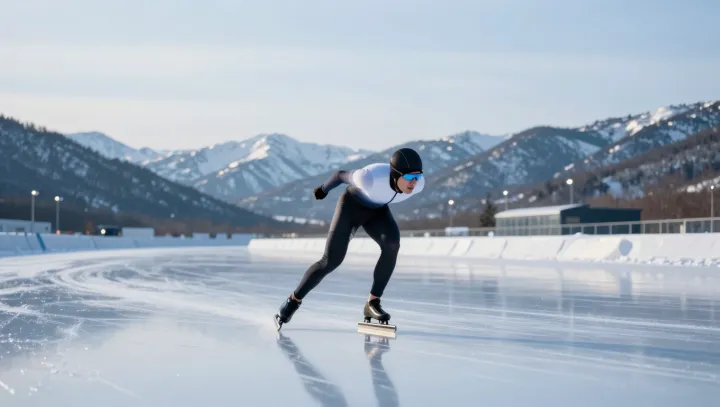
That absurd lean is not bravado; it is geometry made visible. The tilted body lines up almost perfectly with the resultant of gravity and centripetal force, so the skater is not fighting the turn but sitting inside it. To the eye it looks like a fall in slow motion. To a physicist it is vector alignment done at race pace, with error margins measured in millimeters of ice contact.
Control, not courage, decides whether that lean holds. By driving pressure into the inside edge, the skater boosts friction just enough for the required centripetal acceleration, yet not so much that the blade bites and stalls. The steel is slightly rockered and hollow-ground, which creates two sharp edges and a thin water film from pressure melting. That micro layer lowers bulk friction but still supplies lateral grip, so the blade can glide forward while resisting the sideways slide trying to throw the skater off the curve.
The real trick is that balance is outsourced to motion. At rest those angles would topple any human, because the center of mass would sit well beyond the tiny base of support. At speed, the base of support is effectively widened by the arc of the turn and the continuous redirection of momentum. Muscles fine-tune this moving tripod, modulating ankle inversion, knee flexion and hip rotation so that blade pressure, edge angle and friction co-operate. The skater feels risk; the equations see stability.