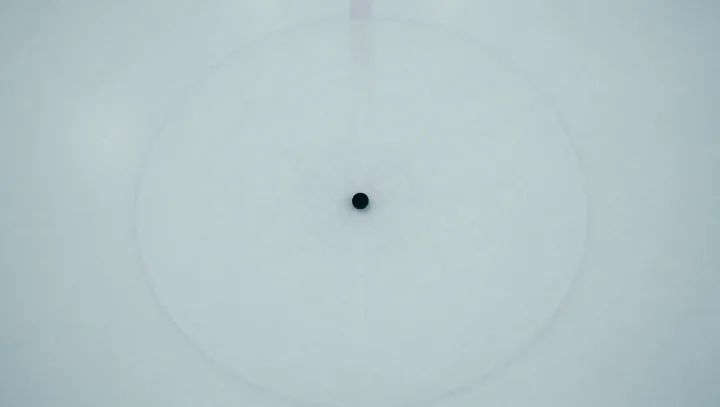
That dead‑still puck at center ice is lying. Nothing about the next second is calm. Beneath that pause sits a tiny disk about to enter a regime where kinetic energy spikes from near zero to thousands of joules as a composite stick bows, then snaps forward like a loaded spring.
What looks simple is actually a physics knife fight. The stick stores elastic potential energy in its carbon fiber matrix, then unloads it in a few milliseconds, driving the puck from rest to triple‑digit kilometers per hour over a few meters. Friction briefly helps, not hurts: static friction between blade and vulcanized rubber lets players “cup” the puck, extending contact time so impulse, the integral of force over time, climbs far higher than a simple tap.
The real mismatch is not puck versus ice but puck versus brain. Human visual processing and motor response stack up to a reaction window longer than the puck’s entire flight from blue line to goal. By the time retinal photoreceptors convert photons into neural signals and synaptic transmission triggers a muscle contraction, the puck has already crossed the line. That frozen moment at center ice is not a pause; it is the last frame the human nervous system can genuinely own before physics takes control and outruns the blink.