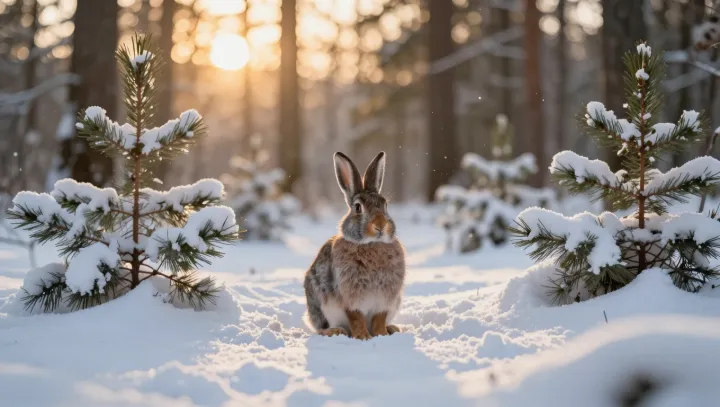
Cold does not chase the rabbit; the rabbit starves it. In fresh snow, a still body is not a sign of surrender but of energy economics, as the animal relies on dense pelage, a lowered metabolic rate, and geometry to slow the relentless flow of heat from warm core to freezing air.
Counterintuitive as it looks, motion would be a liability here. Every hop drives convection across the body, stripping away the thin boundary layer of warmed air that clings to the fur and forcing muscles to burn more fuel. By sitting tight, the rabbit lets conduction through snow and convection in air settle into a slower, more predictable gradient, turning stillness into a thermal strategy rather than a sign of fear.
Most decisive is shape. A compact posture means less surface area for every unit of body mass, a simple ratio that governs radiative and convective heat loss as surely as any equation in a physics class. Paws and ears, rich in blood vessels and prone to rapid cooling, are tucked against the torso, where countercurrent heat exchange and thick fur act together. In that small, rounded form, heat is not heroically produced. It is quietly retained.