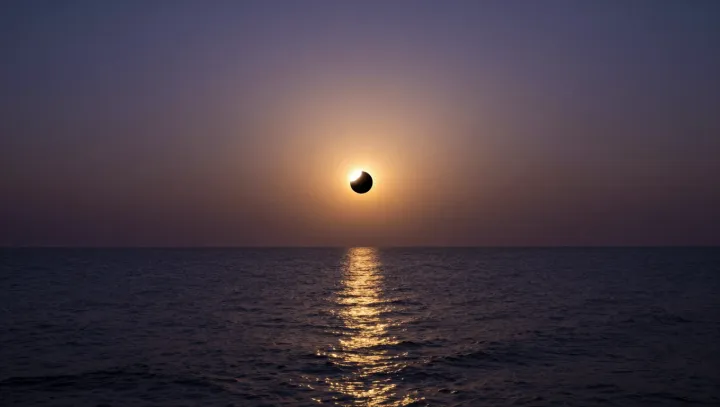
That eerie “blood Moon” is not dark at all. During a total lunar eclipse, the Moon sits fully inside Earth’s umbra, yet its surface still receives a thin halo of redirected light, shaped entirely by the physics of refraction and scattering in the air around our planet.
What really matters is that Earth behaves like a planetary lens. Sunlight skims through the atmosphere, its path bent inward by refraction, so the rays curve into the shadow cone instead of missing it. Shorter wavelengths are stripped away by Rayleigh scattering, which preferentially removes blue and violet photons and lets the longer, redder wavelengths survive the journey through dense atmospheric columns near the limb.
The bolder claim is this: an eclipsed Moon is lit by a ring of fire you cannot directly see. Every point along Earth’s sunrise and sunset belt sends a sliver of filtered sunlight into space; integrated over the full circle, those grazing beams form a dim, coppery spotlight on the lunar surface. Volcanic aerosols, dust, and clouds modulate this radiative transfer, deepening the red if the atmosphere is loaded with particles or leaving the disk a dull gray when the path is unusually clear.