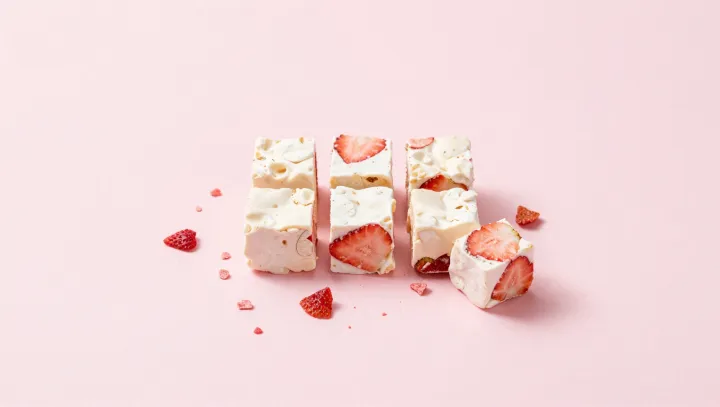
That soft, powdery bite is not an accident; it is engineered against sugar’s instinct to lock itself into rock-hard glass. Inside those berry-studded nougat cubes, scientists treat sucrose less like a pantry staple and more like a volatile construction material, adjusting its form, its partners and its microscopic surroundings to keep it from lining up into rigid crystals.
The key heresy is simple: pure sugar is the enemy of soft candy. By blending sucrose with glucose syrup or invert sugar, technologists disrupt the orderly lattice that sucrose prefers, a classic intervention in crystallization kinetics. These “interfering” sugars bend the way molecules pack, slowing nucleation so that the mass sets into an amorphous glass phase, not a brittle pane. Tiny shifts in concentration tilt the whole structure toward chew or crumble.
Just as subversive is the way they ration water. Texture hinges on water activity, not total moisture, so formulators sneak in humectants such as glycerol or sorbitol that bind water tightly and keep it from migrating into the berries. That bound water acts as a plasticizer, lowering the glass transition temperature and giving the nougat that tender, almost powdery fracture instead of a jaw-testing snap.
Fat and protein then serve as quiet traffic cops. Thin films of cocoa butter or nut oils wrap sugar domains and berry particles, creating physical barriers to crystal growth, while whipped egg white or milk proteins stabilize microscopic air cells. Those air pockets break up the sugar matrix, scatter mechanical stress and make each cube crumble softly between the teeth rather than shatter.