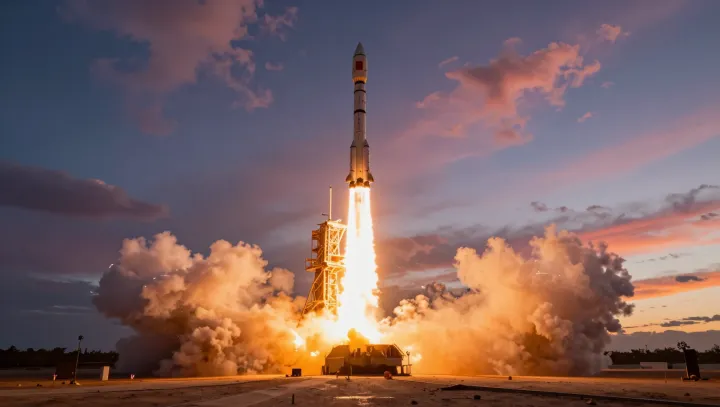
That fragile plume is a lie told by distance. At the nozzle throat, exhaust roars out at hypersonic speed, with temperatures hotter than molten rock and chamber pressures far above the surrounding air. Yet within a short stretch, expansion fans spread the gas, pressure collapses toward ambient, and the once coherent jet begins to fray. Energy that looked concentrated enough to carve stone is already being traded away for volume.
The real trick is how quickly violence becomes structure. Compressible flow and nozzle expansion turn chemical energy into directed momentum, but as Mach number stays high while density falls, the jet couples less and less to the surrounding atmosphere. Shock diamonds flicker where pressure briefly overshoots and undershoots equilibrium, then decay as viscous mixing and molecular diffusion take over. The flow is still fast. It just has almost nothing left to push against.
Calm air wins by doing almost nothing. High-altitude air is thin, static, and offers little drag, so the exhaust column stretches, cools radiatively, and condenses into a pale trail of water droplets and soot rather than a battering ram of gas. By the time the rocket becomes a bright point against the dim desert sky, its exhaust is mostly a ghost of momentum, visible to spectators yet barely able to stir the air around it.