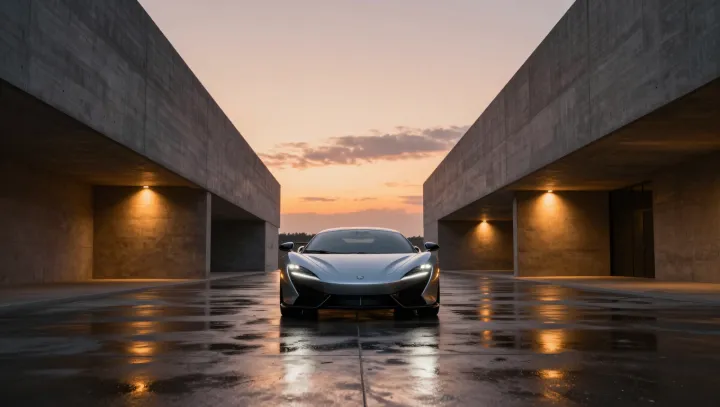
A parked supercar should feel static, yet under a low concrete overhang at sunset it often feels faster than it is. That charged impression starts with pure optics: high contrast lighting drives stronger responses in edge detection circuits of the visual cortex, where neurons tuned to luminance gradients fire more intensely when hard shadows slice across bodywork and ground. Short, dark bands under the car mimic motion blur cues, so the brain quietly upgrades a resting object into a latent projectile.
More deceptive still is the geometry. A heavy slab above the car and a tight frame around it create a forced perspective corridor, which biases depth perception algorithms such as stereopsis and motion parallax expectation. Your brain predicts where such a low, wide form would move inside that tunnel and preloads a sense of momentum. Specular reflections on glossy panels then act like fake velocity vectors; shifting highlight streaks resemble optic flow patterns that normally arise when objects sweep across the retina.
The result is not just a pretty picture but a cognitive hack. By stacking high spatial frequency contrast, occlusion, and directional framing, the scene overstimulates neural pathways used for speed estimation and motor planning, so horsepower feels inflated even at idle. Open daylight, with softer gradients and fewer boundaries, starves those same systems of triggers and leaves the same car oddly honest, and almost slow.