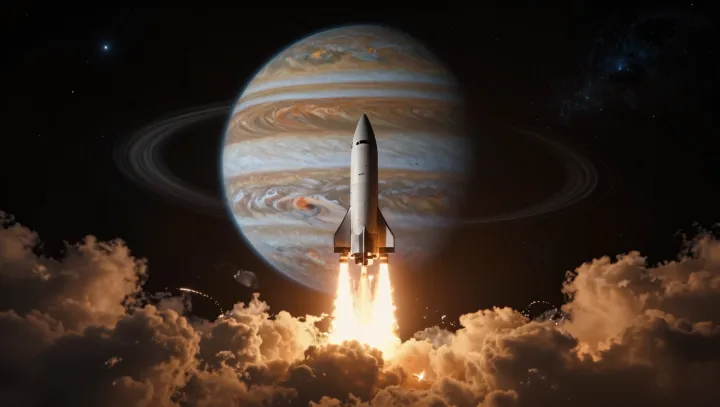
Gas giant proximity is less a thrill than a liability for any starship. Gravity wells stack, atmospheres flex, and every plotted trajectory ages in minutes as pressure waves reshape the upper layers. Rather than trust a single line on a chart, mission planners now treat a route near such a world as a volume, a probabilistic corridor whose edges are defined by worst case shear, radiation belts, and local escape velocity.
The harsh truth is that geometry, not pilot skill, does most of the work. Astrodynamics teams anchor routes to stable solutions of the restricted three body problem and to invariant manifolds that behave like invisible rails, reducing propellant burn while keeping a buffer from storm tops and magnetospheric spikes. Around that skeleton, onboard guidance runs constant sensor fusion, folding in Doppler lidar, magnetometer data, and atmospheric spectroscopy to refresh estimates of density, wind vectors, and gravity harmonics on the fly.
What keeps ships intact, though, is a bias toward retreat baked into the code. Flight computers pre compute abort spirals and powered fly out options, updating delta v margins every few seconds as drag and turbulence erode the plan. Instead of a proud, single pass, modern gas giant operations resemble a series of conditional bets, each short segment cleared only if the next sensor sweep says the corridor ahead is still open.