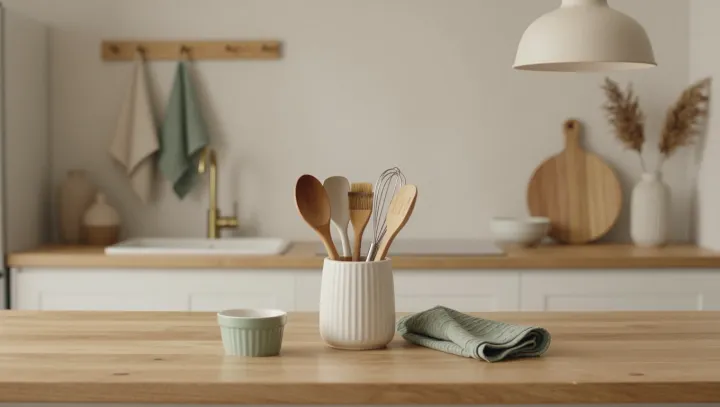
A plain utensil holder sitting by the stove is not storage; it is a script. Around it, two hanging towels turn a messy, improvisational kitchen into something closer to a repeatable protocol than a domestic stage play.
The sharper claim is this: most home cooks lose minutes not to chopping or simmering, but to context switching and micro-decisions. Cognitive psychology calls this working memory overload, and industrial engineers answer it with fixed workstations and standard operating procedure. Place tongs, spatula, ladle, and whisk in one upright holder at arm’s reach and you mimic a production line tool rack, trimming reach distance, search time, and error rate every time a pan heats up.
Even more underestimated is the towel pair. One towel, always on the same hook, is wet-facing: hands only, quick rinse, quick dry. The other is dry-facing: handle grabs, pan stabilization, emergency potholder. By locking in those roles and positions, you are applying task segmentation and reducing what psychologists term decision load. You stop asking, “Where’s a towel?” or “Is this one clean enough?” and instead run a pre-programmed loop: move, grab, wipe, return.
The payoff is not drama; it is boring consistency. Shaving a few seconds from each reach, wipe, and tool swap compounds across a week of meals, just as a well-designed assembly cell does in a factory. What you gain back is not only cooking time but a noticeably quieter mind while the burner stays on.