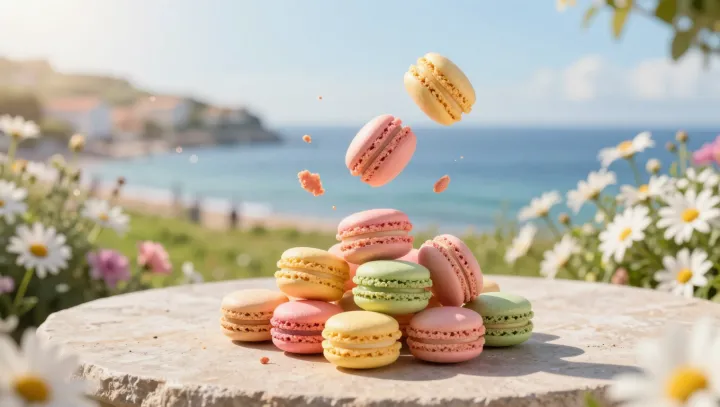
The real surprise is that sweetness barely explains what your teeth report. A macaron’s shock factor is governed instead by physics and anatomy: how a brittle shell fractures, how a viscous filling flows, and how that combo loads your enamel and the nerves buried beneath it.
Shells that differ by a fraction of a millimeter create different fracture mechanics. Thin shells fail fast, sending sharp stress peaks through enamel and into dentin, where mechanoreceptors fire a crisp, high‑definition signal. Thicker shells distribute force, slow the crack, and mute that signal, so the same sucrose concentration feels oddly gentler and less aggressive on first bite.
Filling texture then rewrites the story. A dense ganache with high elastic modulus resists deformation, keeping bite force high and prolonging compression of the periodontal ligament. A looser buttercream behaves almost like a hydraulic cushion, spreading load and changing how saliva dissolves sugar, which alters diffusion gradients at the tongue and gums. Identical grams of sugar, different kinetic profile, different mouthfeel.
Even food coloring, usually dismissed as cosmetic, subtly joins in. Certain pigments tweak surface energy and micro‑porosity of the shell, shifting how quickly moisture migrates and how the crust stales. That changes acoustic feedback and crumble pattern, both tightly wired to oral somatosensory cortex. To the nutrition label, those macarons match. To your teeth, they barely belong to the same species.