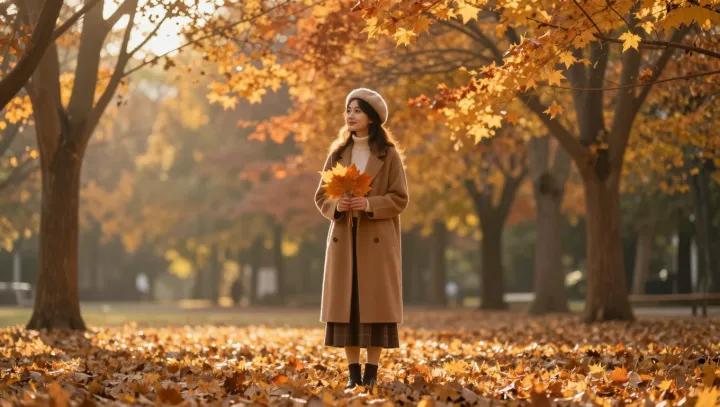
Golden air does the styling long before any influencer enters the frame. When foliage, pavement and sky sit inside the same warm spectrum, the scene behaves like a near-monochrome print, and color theory quietly rewrites the dress code for anyone who wants to stand out without shouting.
The counterintuitive truth is that a nearly colorless camel coat pops harder than scarlet in this setting. By matching the correlated color temperature of late-afternoon light, camel fabric acts like a calibrated white balance card, aligning with the ambient Kelvin range so the sensor compresses hues and frees up dynamic range for micro-contrast in folds, seams and facial features.
Bright primaries, by contrast, fracture that harmony. They drag the eye sideways, but not deeper, because the camera’s exposure metering and hue clipping work overtime to tame saturation spikes, flattening texture and skin tone. A camel coat and beret, sitting just a step darker than the background leaves yet lighter than the shadowed street, become the cleanest edge in the frame, the sharpest luminosity jump.
That is why stylists quietly favor tonal dressing for autumn shoots. They are not chasing color; they are engineering figure-ground separation. When clothing tracks the scene’s dominant wavelength yet nudges the histogram away from mid-tone clutter, the wearer turns into the decisive contrast event in an otherwise seamless field of gold.