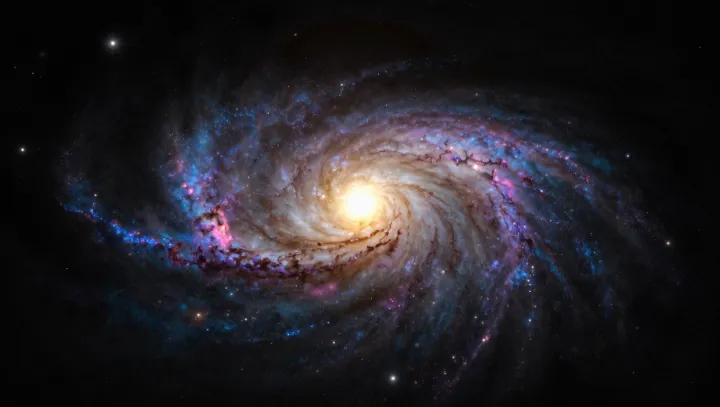
A galaxy is not a single community; it is a city split by physics. Its bright core hoards old stars because violent early mergers and rapid gas collapse once fed a burst of star formation that exhausted cold fuel there, while intense radiation and supermassive black hole feedback keep much of the remaining gas hot and unable to condense.
By contrast, those narrow spiral arms are factories, not ornaments. Spiral density waves sweep through the rotating disk and briefly raise the gas surface density, pushing molecular clouds over the threshold where gravitational instability and Jeans collapse can act, so fresh clusters ignite along the arms while the spaces between them stay relatively quiescent and gas rich.
The odd result is a galaxy running two different star‑formation regimes in one disk. In the crowded bulge, deep gravitational potential and stellar feedback maintain a hot, low‑yield environment; out in the cooler disk, shear, shocks and differential rotation keep compressing the interstellar medium just enough for new stars to flicker on, tracing those delicate spirals against an ancient core.