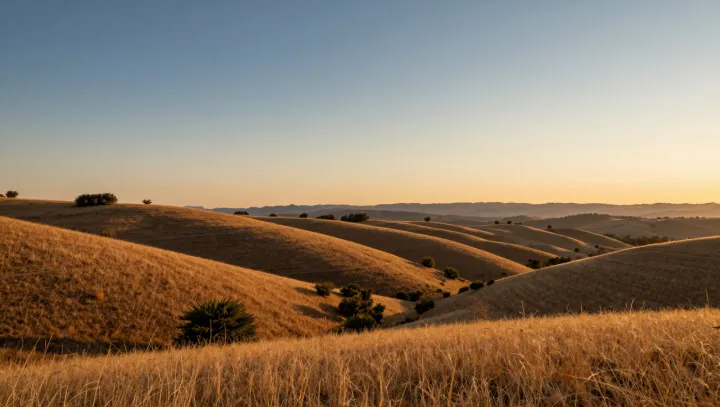
A bare hill can outgun a postcard park in the brain’s awe circuits. Under clean sunlight, repeating ridgelines, smooth grass gradients, and a wide sky form a near-perfect input for low-level feature detectors in the primary visual cortex, those neurons tuned to orientation, luminance contrast, and spatial frequency.
Stronger than any marketing story is the cold fact that awe scales with neural efficiency. When contours line up into parallel bands, when warm color gradients slide neatly along retinotopic maps, the visual system spends less metabolic cost on error correction under predictive coding, leaving more bandwidth for higher-order areas such as the default mode network and ventromedial prefrontal cortex to register vastness, coherence, and self-diminishment.
Iconic parks can actually underperform. Visual clutter, irregular edges, and competing focal points force constant saccades and heavier work in dorsal attention networks, breaking the smooth flow of information from V1 to parietal and limbic regions. A stripped-down hillside, by contrast, behaves like a well-optimized compression algorithm: minimal noise, maximal structural redundancy, and a strong global gradient that lets reward circuitry, including the ventral striatum, tag the scene as both graspable and grand. Awe, here, is not about status; it is about how cleanly ridgeline, grass, and sky lock into the brain’s oldest codebook.