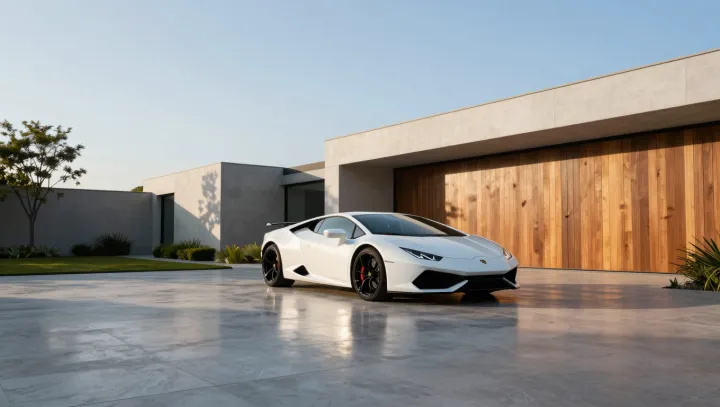
Bare concrete looks boring. It is actually a perfect calibration grid for autonomous supercars. A driveway stripped to planes, lines and a few shrubs gives computer vision and LIDAR a clean signal, free from visual clutter and random signage noise.
The real bet is that private property will become the first dense training arena for home-grade autonomy, long before public traffic rules catch up. On these short stretches, engineers can tune depth maps, semantic segmentation and sensor fusion against repeatable conditions, from wet concrete reflectance to low-angle garage lighting and irregular curb edges.
Design minimalism here is not an aesthetic flex; it is a data strategy. Fewer textures and objects sharpen object-detection thresholds, expose edge-case failures in path planning, and let high-resolution radar be benchmarked against camera-only perception without pedestrians or delivery vans adding chaos.
The quiet twist is economic. Homeowners already pay for resurfacing and landscaping; automakers and home robotics firms can leverage those renovations as a distributed, closed-loop test network that thickens their software moat, while homeowners get driveways that are both visually calm and machine-readable.
So the smooth slab outside the front door starts to function less like a static piece of real estate and more like a private proving strip, teaching machines how to see the threshold between street and shelter.