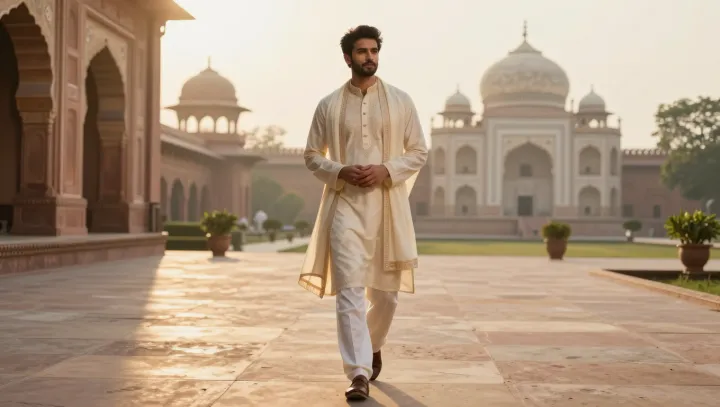
Low sunlight makes the strongest case for ceremony, slipping under each arch and casting long bands across the ground, where an empty courtyard might otherwise read as neglected. Nothing needs to move. The light performs the work, exposing recesses, piers, and thresholds that noon would flatten into a single pale plane.
The arches are doing more than decorating the walls. Repetition creates visual rhythm: each opening echoes the last, and the eye begins to measure intervals as though following a formal procession. This is serial repetition, not ornament alone. Through linear perspective, the farthest arch contracts while its shadow narrows, giving the enclosure direction, scale, and an implied order.
Emptiness, then, is not absence but reserve. Raking light sharpens luminance contrast and makes depth legible through occlusion, so the courtyard gains a hierarchy without furniture, crowds, or ceremony itself. The space feels prepared. Under those measured arcs, even silence seems to have been arranged.