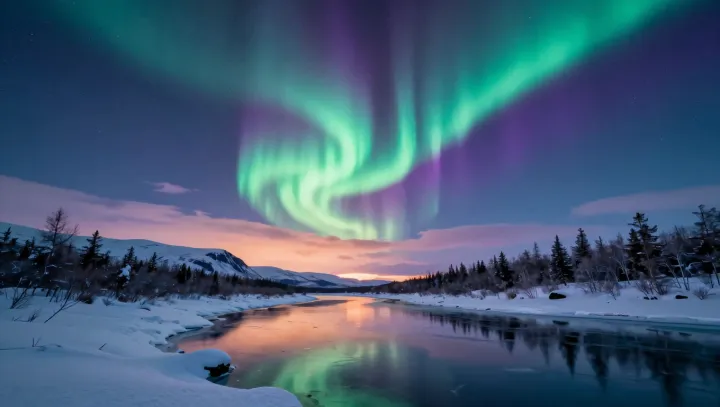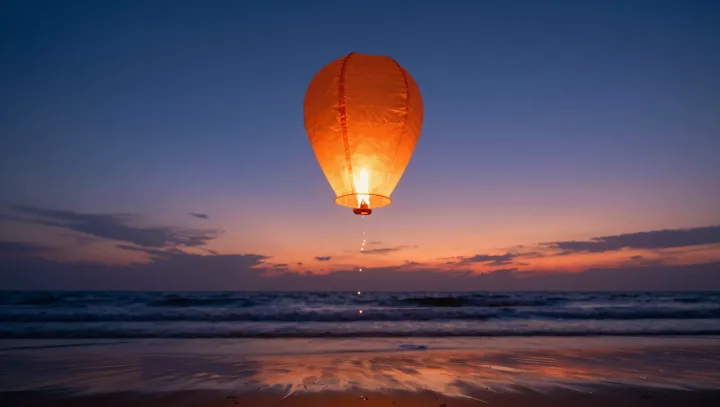
No flight repeats. A paper lantern rises from a shore into air that is already layered, sheared, and unsettled; its flame warms the envelope, changes buoyancy, and hands the craft to winds whose speed and direction vary with height. The launch point is fixed.
The obvious explanation is incomplete. Even a steady breeze at ground level conceals a vertical wind profile, while friction near water and land builds a boundary layer where gusts, eddies, and thermal plumes alter each ascent. Tiny differences matter. At the shoreline, surface roughness produces mechanical turbulence; farther up, differential heating can generate convection, while humidity changes density and uneven heating moves those fields before the lantern reaches them. Physics keeps score. A fraction of a second in release timing, a slight tilt in the lantern, or a small change in flame output shifts its initial state; turbulence then amplifies that shift through sensitive dependence, producing separate Lagrangian trajectories.
Chance is not random. It is the measurable behavior of a chaotic fluid system, in which no observer can specify every pressure fluctuation, temperature gradient, humidity pocket, or vortex met by a light, heating object. Prediction has limits. Measurements can narrow a forecast, but they cannot recover the exact sequence of microscale encounters that bends one ascent away from another. No route can be copied once deviations compound. Two lanterns may drift broadly alike, yet their paths separate because air carries forward small disturbances. Above the dark water, each flame writes once, then disappears.