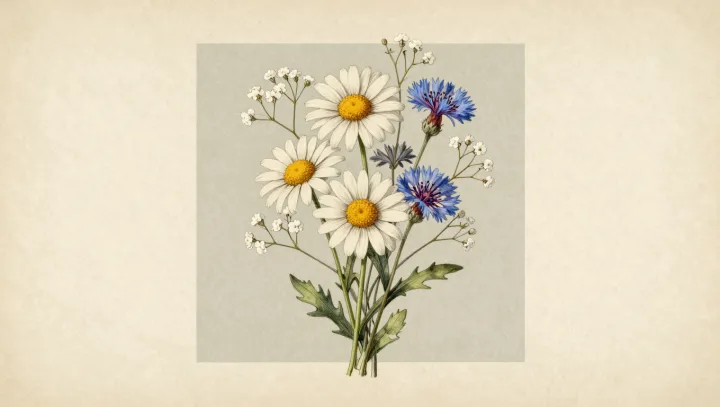
At dawn, purple flowers can look lit from within, though every photon they send outward was first borrowed from the sky. The trick is perceptual. Against foliage still sunk in shadow, petals reflect a mix of short and long wavelengths, while the eye, adjusting to thin light, reads their edges as unusually clean and bright.
The eye misleads. Under dim illumination, photoreceptors change the terms of the bargain: rods gain influence as cones lose precision, a shift known as the Purkinje effect. Not a minor correction. Purple itself is not a spectral color; the brain assembles it from red and blue signals, while rods respond poorly to red. That mismatch matters. Rods favor blue-green wavelengths, so the blue side of a purple petal can carry more visual weight beside dark leaves.
The flower is no lamp. Its anthocyanin pigments absorb some wavelengths and reflect others; epidermal cell shape, surface scattering, and cool skylight can sharpen the display without adding energy. No magic involved. Microtextures on petals may scatter incoming light across several angles, allowing a bloom to catch the eye before direct sun arrives. What seems like radiance is a negotiated illusion between petal, atmosphere, and retina.